
For Immediate Release: March 5, 2026
Contact: Kristin Ginger, Director of Communications & Development, Housing Action Illinois, kristin@housingactionil.org or 312-854-3333
CHICAGO, IL – A new report by Housing Action Illinois and the National Low Income Housing Coalition (NLIHC), The Gap: A Shortage of Affordable Homes, finds a national shortage of 7.2 million affordable and available rental homes for extremely low-income renter households—and only 34 affordable and available rental homes for every 100 of these households in Illinois.
These findings come amidst multiple proposed rules from the Trump administration that will make it more challenging to promote access to federally subsidized rental homes.
“We need federal policies that increase the availability and access to affordable housing, not attempt to take it away or make it more difficult to qualify for,” said Bob Palmer, Policy Director for Housing Action Illinois.
These harmful rules include:
- Allowing Public Housing Authorities (PHAs) and owners of project-based rental Section 8 assistance to implement time limits and work requirements. The proposal ignores that federal programs are necessary because of the high cost of housing in the private market, not because people aren’t already working or don’t want to work if they are able. More than half of non-disabled, working-age Illinois households receiving federal rental assistance include at least one worker.
- Changing federal law and ending long-standing federal policy by prohibiting families with mixed immigration status from receiving housing assistance and creating burdensome citizenship documentation requirements for U.S. citizens. Contrary to HUD’s false claims, people who are undocumented do not receive housing subsidies under current policy. If the eligible individual is part of a mixed status family, the family receives prorated housing assistance only for the eligible individual. These families therefore pay a higher amount of rent than other households.
- Eliminating the requirement that PHAs and property owners receiving HUD funding to provide 30-day written notice for nonpayment of rent prior to eviction. Without the protection of the 30-day notice rule, HUD tenants in Illinois could be evicted with only 5 days notice to pay what is owed.
“Without the 30-day notice rule, the tenants we serve in Illinois will be at much higher risk of losing their housing due to rent that they don’t even owe. HUD multifamily housing owners make ledger errors and miscalculate balances that families need time to resolve,” said Noah Moskowitz, Organizing Director for the Jane Addams Senior Caucus. “By rescinding this rule, HUD is forcing our families through an impossible five-day timeline to address administrative errors, pay the erroneous charges, or face homelessness.”
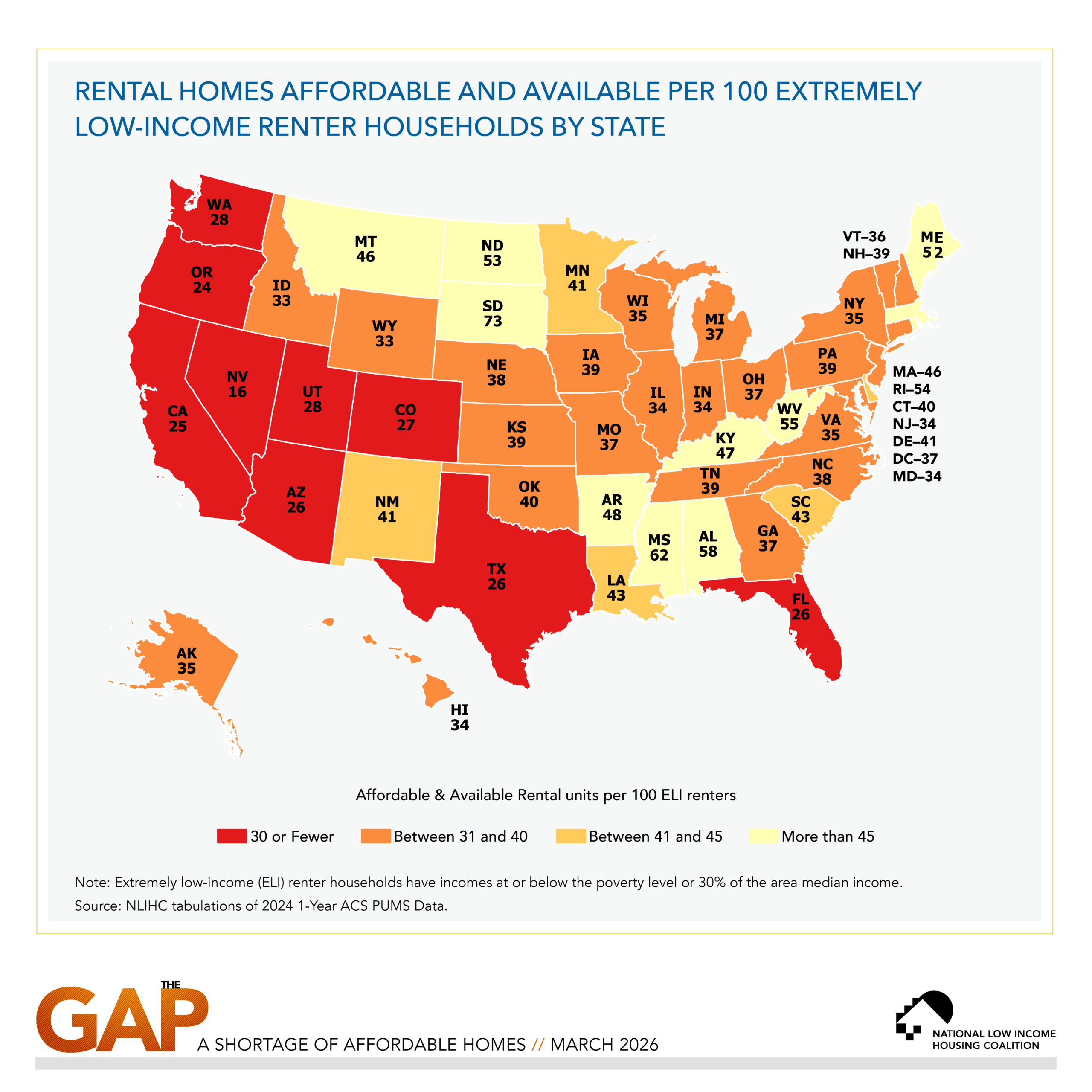
The report finds that 439,933 extremely low-income renter households live in Illinois, but only 150,317 affordable rental homes are available to them—leaving a staggering shortage of 289,616 affordable rental homes. Extremely low-income households have annual incomes at or below 30% of their area median income (AMI). As a result, 74% of extremely low-income renters in Illinois are severely housing cost-burdened, spending more than 50% of their income on housing, with little left over for food, healthcare, and other basic necessities.
The picture is even worse in the Chicago metro area, where only 31 affordable and available homes exist per every 100 extremely low-income renters.
Even for those with a slightly larger household budget, there are not nearly enough options available; in Illinois, there are only 63 affordable and available rental homes for every 100 very low income households in Illinois. Very low income households have annual incomes of 50% or below AMI.
The private market alone cannot provide an adequate supply of housing affordable, especially for the lowest-income renters. Investments are needed to produce new affordable housing, preserve existing affordable housing, and subsidize the difference between what the lowest-income renters can afford to pay and market rents.
Released annually, The Gap investigates the affordability and availability of rental homes for households of different income levels nationwide and in every state and major metropolitan area. For the full report, visit: https://nlihc.org/gap
###
About Housing Action Illinois
Housing Action Illinois has been leading the movement to end homelessness, address the shortage of affordable rental housing, and expand homeownership opportunities in Illinois for nearly 40 years. With our 200+ member organizations, we bring everyone together to work toward our vision of an Illinois where everyone has a stable, good home.