
July 2025 marked the third year of Housing Action Illinois’ work in the City of Cairo, IL, a collaboration focused on addressing longstanding housing challenges and how to create the conditions for future development. After completing a plan to identify strategies to incentivize new construction in Cairo, Housing Action is now working to secure the resources needed to make this plan a reality in the coming years.
Cairo’s population has shrunk with increasing rapidity over the past several decades, a trend accelerated by the condemnation of two of Cairo’s largest housing developments in 2019. When these buildings were torn down, there were not enough available units in Cairo for displaced residents to move into, forcing them out of the community. Notably, there hasn’t been a new residential development in Cairo in around 50 years, creating a cycle in which industries don’t consider the community because there is nowhere for employees to live, and developers hesitate to build there because of limited employment opportunities. This disinvestment expands beyond large-scale industry jobs; residents need to travel to neighboring towns for basic needs such as gas or groceries.
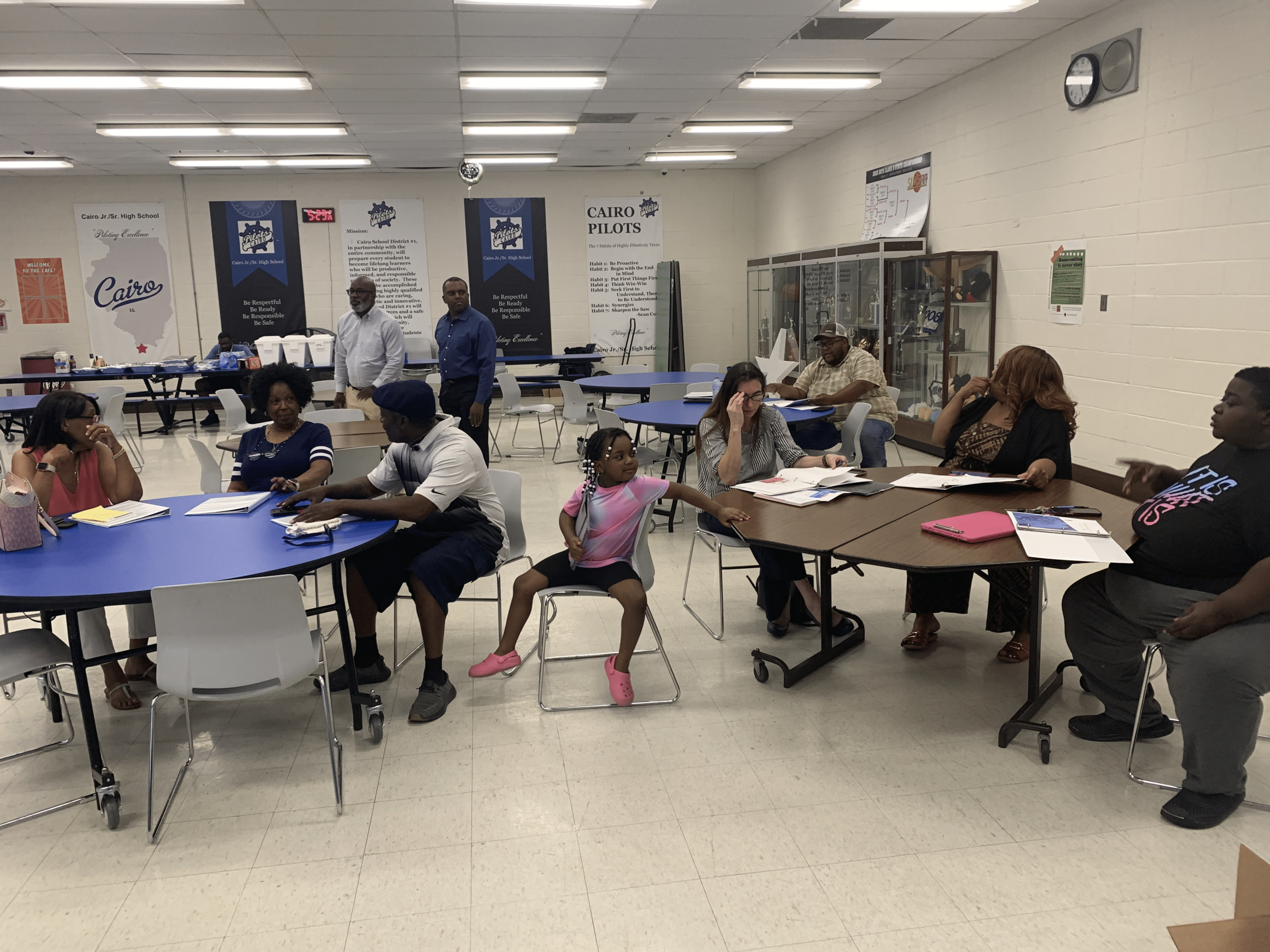
Cairo residents at a community meeting in June 2025.
Earlier this year, Housing Action released the Cairo Housing Needs Action Plan, a report that assesses the current housing situation in Cairo and provides a roadmap for the next steps to improve the quality of housing, expanding options, and laying the groundwork for economic revitalization. A core principle of the plan is that meaningful, lasting progress must be shaped in partnership with Cairo residents.
Building trust has been central to this work. “A lot of promises have been made to residents–about a lot of things that never happened.,” says David Young, Housing Action’s Director of Capacity Building. “There was definitely some wariness and some suspicion when we first got there, and it took time to build up trust and a level of comfort before we could start writing this plan. After the plan was released, we went back to residents to go over the recommendations with them, to see what they thought, find out what they considered most important, and start to move those things forward.”
“There’s not enough housing for the whole lifecycle. If I’m a teacher, I could afford a certain level of housing, but others might not be able to afford that. We need housing that fits everyone at every level,” says one resident, highlighting the need for more diverse housing stock in the city. “The housing that is available needs a lot of work [such as] maintenance, roofs, updated systems, outdated kitchens and bathrooms, weatherization & energy efficiency,” says another. The existing housing in Cairo is unable to adequately support even the remaining population.
To break the cycle of disinvestment in Cairo and encourage housing development, Housing Action recommends lowering cost and labor barriers. A key strategy for this is developing pre-approved building plans which the city can provide to developers, drastically reducing the pre-development costs of building in Cairo. These plans can also be provided to landowners who are interested in constructing their own home. This also gives the citizens of Cairo some say over what development in their city looks like while also incentivizing outside investment.
This year, Housing Action also secured funding from the Office to Prevent and End Homelessness to bring on the Southern Illinois Community Foundation as a grant writing partner. Their support will help identify funds to implement the plans.
“We didn’t want to be an organization that is hired to write a plan, then puts the plan up on the shelf, and you never think about it again,” David explains. “We want to say, here are our recommendations, and now that you’ve told us which things are important, we’re going to help you try and implement them. Now is it going to take a year? Could it take two years? It might take five years, but we want to build the infrastructure. We want the tools in place for Cairo so that when someone comes and says, hey, we’d like to develop something, there’s no friction in the process.”
We realize these plans will be challenging, but the commitment from the city, its residents, and our partners remains strong. Together, we plan to continue laying the groundwork for new housing, renewed investment, and a more vibrant future for Cairo.